As the 2026 Responsible Gaming Education Month (RGEM 2026) continues through the end of September, not a week goes by without a casino company, industry trade association member, or responsible gaming research provider issuing a press release touting their ongoing efforts to address problem gambling behavior. To their credit, the American Gaming Association (AGA), and its responsible gaming (RG) advocates have consistently promoted policies to reduce problem gaming through education, public information, and employee training. Nonetheless, these RG advocates continue to ignore the most obvious public policy change that would reduce the incidence of problem gambling behavior, specifically, calling for a total ban on smoking in casinos.
While there is an abundance of research into problem gambling behavior that identifies comorbidity among problem gamblers and a variety of other aberrant behaviors, including smoking, no study has managed to connect the dots, and link smoking while gambling to problem gambling. In fact, the causality is hiding in plain sight.

Today’s Reality
For anyone who has smoked, or for anyone who keeps company with a smoker, they know that the physical craving for a cigarette occurs during the course of every day. For some, that desire may come every 15 minutes while for others, it may be every hour. Regardless, the craving comes, and it needs to be satisfied. In a casino that permits smoking, that craving can be satisfied by simply lighting up.
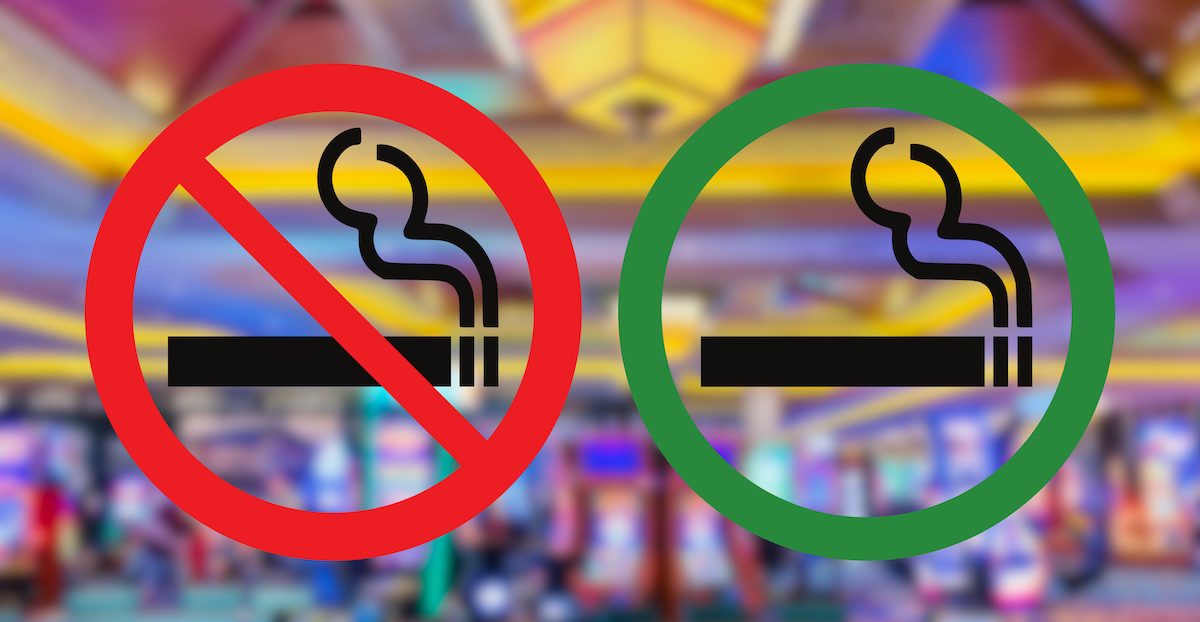
In those 12 states where smoking inside commercial casinos is prohibited, smokers must leave their favorite game and step outside to satisfy that craving. For customers who play in those 17 states that have carved smoking loopholes that permit smoking in commercial casinos as well as in states with Indian casinos, customers can continue to play while smoking. They do not need to take a break. They can just stay focused on the game.
In fact, it was a 2021 study commissioned by the Casino Association of New Jersey that sought to identify the economic impacts of banning smoking on casino floors that brought to light to this author the link between smoking and problem gambling behavior. In its analysis, that report stated in part:
“Some gamblers may have a fixed amount of time to play, which for a smoker could result in lower GGR for the casino due to the smoking breaks…It is also possible that the smoker during the first or second break would cut his or her losses and leave the casino…”
That last sentence revealed why, albeit unintentionally, what casino operators fear: that a smoker who walks away from a game in order to take a cigarette break might decide to cut their losses and call it a day, or worse, take their winnings and go home.
What the cigarette break does is provide a smoker with a pause from the excitement of the gaming floor. It gives the player a chance to think—or just a moment to relax and reflect on something else. In fact, that behavior adheres to a fundamental principle of responsible gaming and one advocated by the AGA. In a press release issued on June 25, 2025, which announced the launch of its “Play Smart From the Start Consumer Hub,” the AGA advised gamers to “set a budget, take breaks, and stay aware, win or lose.” That advice remains true to this day, and can be found in a variety of collateral material published by the AGA.
The Beauty of Non-Smoking Policies in Casinos
The beauty of a non-smoking policy that requires customers to step outside in order to smoke is that it is the most benign form of responsible gaming. It does not require any employee training or intervention. It does not require the observation of a slot attendant to recognize that someone has been sitting at a game too long; it does not require that the attendant inform a host; it does not require the host to have a difficult conversation with the player; and it does not in any way offend the guest. It is the simple physical desire for a cigarette that induces the customer to step away from the game.
It is curious that academics, RG counselors, and public policy experts fail to advocate for the one policy that could do more to reduce problem gambling behavior than just about any training program, brochure, or 800 hotline can do. This raises the question: what motivates RG professionals?
Part of the answer may lie in who pays the bills. Much of the responsible gaming ecosystem—research centers, conferences, certification programs, awareness campaigns, and even the problem gambling helplines themselves—is funded directly or indirectly by gaming operators, their trade associations, or gaming tax revenue. It is difficult to advocate for a policy that your funders have spent years, and considerable lobbying dollars, opposing. One does not need to allege bad faith to observe that silence on smoking is a convenient position for anyone who hopes to keep their seat at the table.
In 2022, the executive director of the National Council of Problem Gambling submitted a letter to the New Jersey Senate in support of Senate Bill 264, acknowledging the overlap of smoking and problem gambling, and cited numerous studies that showed an association between those two behaviors, but stopped short of identifying a causal relationship, instead suggesting that more research was necessary.[1] And maybe, that is what responsible gaming is all about: more research, and of course funding to support that research.

Time to Take Action
What is clear in 2026 is that more research into the causal relationship between problem gambling and smoking is not needed. One does not need to have a PhD in behavioral science and a well-funded research grant to see the relationship. What one needs is common sense. By simply adhering to the principles espoused in RGEM 2026 and allow the cravings for cigarettes to induce smoking patrons to take breaks, the industry can significantly reduce the financial impacts of problem gambling on a large number of individual players.
Then there are the people who never get a break at all. Dealers, slot attendants, cocktail servers, and security officers on smoking floors breathe secondhand smoke for entire shifts, despite the U.S. Surgeon General’s long-standing conclusion that there is no risk-free level of exposure. Atlantic City casino workers have organized and lobbied lawmakers for years to demand smoke-free workplaces. An industry that speaks so fluently about the health and wellbeing of its guests during RGEM might reasonably be asked why that concern stops at the edge of the table.
Finally, consider how responsible gaming measures its own success. RGEM press releases count activities: employees trained, pledges signed, brochures distributed, web pages launched. Rarely do they report outcomes—whether the rate of problem gambling in a market went down, or whether individual players lost less. A program measured by activity rather than results can go on indefinitely without ever having to prove that it works. A smoke-free floor, by contrast, would begin producing measurable results the day it took effect.
Casino operators in smoking states would prefer the status quo. Legislators in those states would prefer not to see any disruption in gaming tax revenue. But what about responsible gaming advocates? Do they care about enacting meaningful policies that would reduce the incidence of problem gambling? Perhaps all RG advocates care about is more funding for additional studies, staffing for hotlines, training seminars, counselors, and informational websites. If that is indeed the case, then let the casino operators continue to provide the funding, keep the smoking loopholes in place, and the RG industry can start planning for RGEM 2027.
Andrew Klebanow is the principal at Klebanow Consulting. He has worked in the casino industry since 1977 and as a gaming consultant since 2001. He can be reached at Klebanow@cox.net.
[1] NCPG Statement on S264 to the New Jersey Senate, August 16, 2022.