In The Grasshopper, philosopher Bernard Suits defined playing a game as “the voluntary attempt to overcome unnecessary obstacles.” Take a second to think about what that implies. The value of play, in this account, is not simply winning, it is the chosen struggle. Nobody needs to defeat a difficult boss, solve a puzzle, or improve at chess. We accept those obstacles because overcoming them is satisfying.
That definition raises a parallel question about gambling. If games organize experience around challenge, perhaps gambling organizes it around uncertainty.
A game asks: Can I overcome this? Gambling asks: What will happen next?
Both can be entertaining and deeply absorbing. But they may satisfy different motivations. As games and gambling increasingly borrow from one another, understanding the distinction becomes increasingly important.
Two Loops Of Engagement
Traditional games tend to organize engagement around a challenge loop: challenge, effort, feedback, mastery, and progression. The player meets an obstacle, develops skill or knowledge, receives feedback, and becomes more capable.
Gambling can operate through a different loop: uncertainty, anticipation, resolution, and renewed uncertainty. The player does not necessarily become better at anything. The resolution of uncertainty can be rewarding enough to motivate another encounter with it.
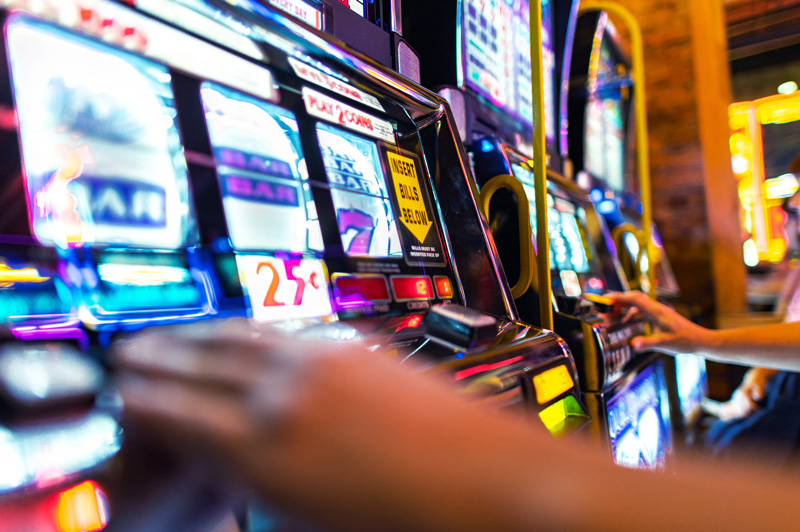
Consider a slot machine. A wager is placed, anticipation builds, the reels resolve, and another opportunity appears almost immediately. There may be no mastery or meaningful progression, yet the loop can remain compelling.
The most interesting design question may be what happens when these loops are combined.
Zoning In And Zoning Out
Challenge-based games are well suited to producing flow. Difficulty and ability interact, feedback is immediate, attention narrows, and the player becomes focused on performing the task. The player zones in.
Some gambling experiences can produce a different form of absorption. Repeated cycles of uncertainty and resolution become rhythmic, time recedes, and awareness of the surrounding environment can diminish. The player zones out.
Flow and dissociation are not simple opposites, and gaming does not always produce one while gambling produces the other. Still, the distinction suggests a useful hypothesis: challenge may absorb us through mastery, while uncertainty can absorb us through repetition and anticipation.
When Progression Becomes Uncertainty
Games normally provide progression vertically, by making the player more capable, or horizontally, by expanding characters, strategies, environments, and ways of playing. Either form preserves an implicit bargain: I play, I learn, I achieve, and I progress.
Many free-to-play products insert monetized uncertainty into that progression. A desired character, item, or ability may sit behind a loot box, randomized drop, gacha mechanic, artificial delay, or paid chance. The loop changes from “I improve and progress” to “I encounter friction, then wait, pay, or take another chance.”
Players can tolerate remarkable difficulty when the obstacle feels legitimate. They may attempt the same boss dozens of times or spend hours mastering a system. Frustration often rises when the obstacle seems designed primarily to induce payment. The problem is not friction itself. Games are made of friction. The problem is whether the obstacle asks the player to become more skillful or merely to purchase another opportunity.
The player stops feeling as though they are playing the game and starts feeling as though the game is playing them.
Uncertainty Can Be The Product
Social casinos and loot boxes complicate the idea that gambling is attractive only because money can be won. People purchase virtual chips, randomized items, and chances to continue playing even when rewards cannot be redeemed for cash.
Virtual rewards can carry status, utility, scarcity, identity, or social value. The player may be purchasing more than an item. They may be purchasing continued access to anticipation and resolution.
This suggests that uncertainty is not merely a feature of the product. In some designs, uncertainty is part of what is being consumed. That becomes particularly powerful when the desired outcome also supports progression, status, or mastery. The gaming loop gives the uncertain reward meaning, while the gambling loop keeps that reward just out of reach.
When Both Loops Reinforce Each Other
Randomness is not inherently harmful. Games have always used card draws, procedural environments, critical hits, and unpredictable opponents. Uncertainty can enrich challenge by forcing adaptation.
The more useful distinction is whether uncertainty exists within challenge or begins to replace it. When uncertainty creates a problem to solve, it can support mastery. When it determines whether the player is permitted to progress, particularly when repeated payment creates more opportunities, the motivational structure changes.
Loot boxes illustrate this interaction. A player wants to complete a collection, acquire a rare character, improve performance, or achieve status. Those goals originate in the gaming loop. Access is then randomized, activating the gambling loop. Mastery gives uncertainty purpose, while uncertainty creates additional barriers to mastery.
Research consistently finds an association between purchasing loot boxes and problem gambling, although the direction of causality remains uncertain. Loot boxes may contribute to risk, people already attracted to gambling may be more attracted to loot boxes, or shared vulnerabilities may explain both. The uncertainty should make us cautious about causal claims, but not indifferent to the design.
Gambling Is Becoming More Like Gaming
The convergence also moves in the opposite direction. Gambling and prediction-market platforms increasingly incorporate rankings, instant feedback, achievements, social comparison, interactive interfaces, and public competition.
Prediction markets are especially interesting because they can involve genuine skill. A participant may interpret information better than others, yet money still depends on an uncertain event. Add rankings, notifications, rapid trading, and social proof, and forecasting becomes a high-stakes game containing both mastery and monetary uncertainty.
Again, the important question is not only which legal category applies. It is which motivational systems the design activates.
Designing Balance
Can gambling be made more enjoyable without simply making it more absorbing? The answer may depend on where the enjoyment comes from.
If enjoyment is increased by accelerating uncertainty, intensifying sensory reinforcement, eliminating pauses, and making repetition frictionless, greater engagement and greater risk may be difficult to separate. But gambling can also draw entertainment from meaningful decisions, social interaction, transparent feedback, intentional pacing, and genuine strategy.
The design target need not be maximum engagement. It could be sustainable engagement, preserving uncertainty as part of gambling without allowing the uncertainty-resolution loop to become the only reason to continue.
Games make us want to overcome. Gambling makes us want to know what happens next. Modern products increasingly know how to make us want both. The challenge is understanding when those systems enrich one another, and when one quietly begins to consume the other.
References
Hing, N., Browne, M., Rockloff, M., Lole, L., & Russell, A. M. T. (2022). Gamblification: Risks of digital gambling games to adolescents. The Lancet Child & Adolescent Health, 6, 357–359.
Rabinovitz, S., & Packin, N. G. (2025). All bets are on: Addiction, prediction, regulation, and the future of financial gambling. Fordham Intellectual Property, Media & Entertainment Law Journal, 36(1).
Suits, B. (1978). The grasshopper: Games, life and utopia. University of Toronto Press.
Wardle, H., & Zendle, D. (2021). Loot boxes, gambling, and problem gambling among young people. Cyberpsychology, Behavior, and Social Networking, 24(4), 267–274.
Dr. Travis Sztainert is director of research and education at the International Center for Responsible Gaming and an adjunct research professor in the Department of Psychology at Carleton University. His work focuses on gambling-related harm, responsible gambling and player protection, knowledge translation, and improving the connection between research, policy, and practice. He is particularly interested in emerging gambling products, innovative approaches to prevention and treatment, and ensuring that gambling policy and responsible gaming initiatives are grounded in high-quality evidence.
Author’s note: The views expressed are the author’s own and do not necessarily reflect those of the International Center for Responsible Gaming (ICRG). This article is based on previous LinkedIn posts and articles by the author.